


Summary
Off-the-shelf software often looks inexpensive because its true costs are spread out, hidden, and normalized over time. But for growing businesses, those hidden costs add up, slowly reducing efficiency, flexibility, and control. The real question isn’t whether software is affordable today. It’s whether it will still support where your business is going tomorrow. Intellithought can help you navigate what's needed for custom software tailored to your business.
At first glance, off-the-shelf software seems like the simplest answer to almost any business problem. It’s fast to deploy, widely used, and often much cheaper upfront than custom development. For many organizations, it feels like the “safe” choice.
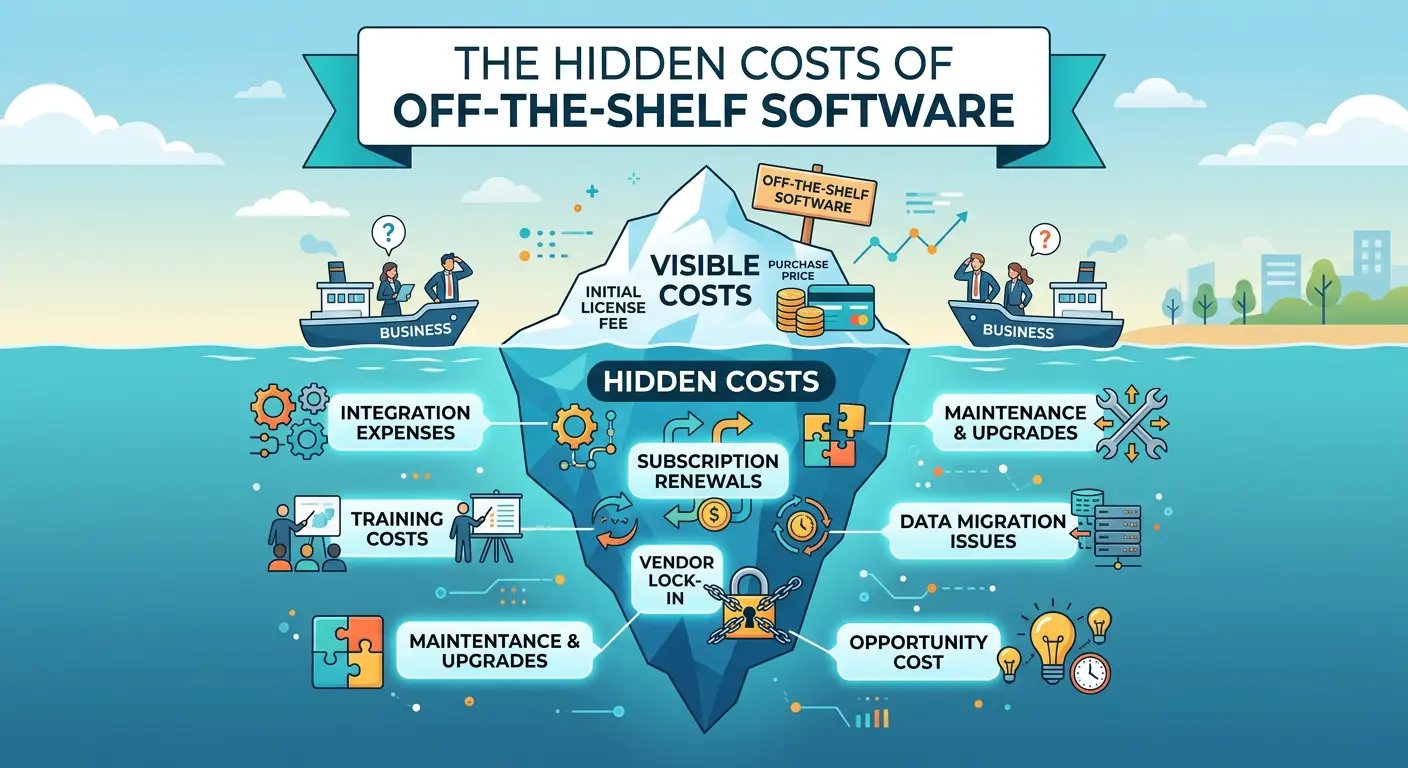
But what’s easy to overlook is that the real cost of software isn’t just what you pay to install it; it’s what you pay every day you use it.
Over time, businesses often discover that off-the-shelf tools come with hidden costs that quietly erode efficiency, flexibility, and even profitability.
Where the Hidden Costs Add Up
1. Paying for What You Don’t Use
Most platforms are built for the masses, not your business. That means you’re often paying for features you don’t need while still dealing with the complexity they create.
2. Inefficient Workflows
One of the biggest hidden costs is subtle: your team adapts to the software. This leads to workarounds, duplicate data entry, and lost productivity.
Instead of asking, “What’s the most efficient way to run this process?” businesses start asking, “How do we make our process fit this tool?”
That shift leads to:
- Workarounds and manual steps
- Duplicate data entry
- Extra clicks and unnecessary approvals
- Employees spending time “fighting” the system
3. Integration Challenges
Connecting multiple tools can require additional subscriptions, custom development, and ongoing maintenance, quickly increasing your total cost of ownership. What looks like a simple SaaS subscription can quietly turn into a complex, fragile ecosystem that requires constant attention.
4. Rising Costs as You Scale
Many SaaS tools charge per user or by usage. As your business grows, so do your expenses, often without delivering proportional value.
5. Limited Flexibility
When your business needs change, off-the-shelf software may not keep up. Off-the-shelf software evolves on its own timeline, not yours.
When you need something slightly different, you’re often faced with:
- “Use a workaround.”
- “That’s not supported.”
- “Submit a feature request.”
- “Upgrade to a higher plan.”
You’re left waiting on updates, upgrading plans, or building inefficient workarounds.
6. Vendor Lock-In Risk
The more deeply a company integrates a platform into its operations, the harder it becomes to leave. Even if a better solution exists, switching becomes difficult, expensive, and risky.
7. Opportunity Cost
Perhaps the most significant hidden cost isn’t financial, it’s strategic. When teams are constrained by generic tools, they miss opportunities to automate unique workflows and build competitive advantages into their systems.
Read More: Business Process Automation Strategy: From Chaos to Efficiency
The Smarter Long-Term Approach
Off-the-shelf software can be a great starting point, but it’s not always the best long-term solution. Custom software isn’t about complexity for its own sake. It’s about alignment.
The key question isn’t “Should we use off-the-shelf software?”, but rather: “Is this tool shaping our business or are we shaping it?”
Ready to Take Control of Your Software?
If your current tools are slowing you down or costing more than they should, it may be time to explore a better approach.
Let’s talk. Intellithought specializes in building custom software solutions that fit your business, not the other way around.